Exercise of the Month: Single Leg Press on the Split-Pedal Stability Chair™
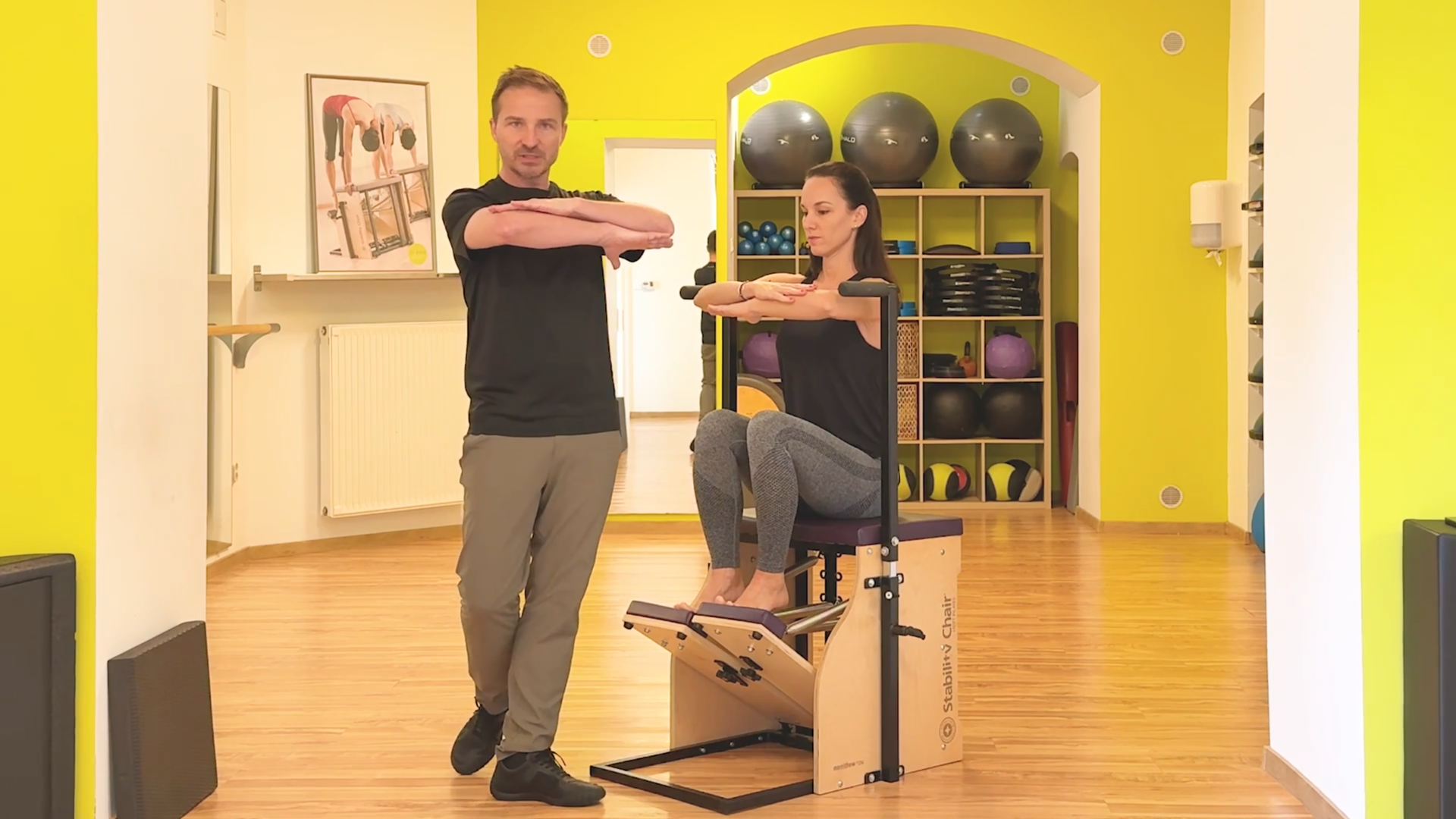
The Single Leg Press on the Split-Pedal Stability Chair™ delivers more than meets the eye. It builds targeted strength, balance and control for powerful, full-body results. This unilateral exercise strengthens the hips, glutes and lower body while enhancing balance, coordination and postural alignment. Aimed at intermediate-to-advanced clients, this movement offers instructors a range of modifications that make it accessible and supportive for beginners and post-rehabilitation clients.
Working one leg at a time, this exercise pinpoints muscular imbalances, builds body awareness and challenges core control. Together, these elements form the foundation for functional everyday movement patterns such as walking, climbing and weight transfer from one leg to the other.
Watch the Exercise
Merrithew® Lead Instructor Trainer Krisztian Mélykuti, owner of Pilates Plus Studio in Budapest, Hungary, guides the instruction of the Single Leg Press on the Split-Pedal Stability Chair™. Alongside demonstrator Laura Kovács, Krisztian shares expert tips and detailed cues to help you practice safely and effectively.
Equipment Set-Up
Suggested spring tension is two heavy red springs on the bottom hooks, and two light blue spring on the top hooks, for a total of four springs. This setup provides enough support for control while requiring precise muscle engagement.
Key Benefits
- Builds Functional Strength – Engaging the glutes, quads and hamstrings to enhance movement efficiency and reduce muscular fatigue.
- Activates Core and Supports Posture – Stabilizing the pelvis and spine to improve alignment and help alleviate back discomfort.
- Improves Balance and Coordination – Training hips, quads and calves to work in sync for smoother, more controlled lower-body movement.
- Identifies Imbalances – Builds movement symmetry to lower the risk of injury from strain and overuse.
- Encourages Proprioception – Supporting refined motor control by increasing awareness of how the body responds to instability.
Krisztian’s Pro Tips
- Find the Right Seat: Sit in the center or slightly forward on the chair for better range of motion and control.
- Balance with Gravity: Cue engagement through the core and a gentle lift through the spine to resist gravitational pull.
- Control the Return: Use the quads and hip extensors to guide the pedal back up. The lift should be as smooth and strong as the press.
- Respect Your Range: Lift only as high as you can without compromising pelvic stability.
- Monitor Pelvic Alignment: Keep both sit bones grounded to avoid shifting or rotation.
Modifications
- Supported Upright Position: If maintaining an upright torso is challenging, use the hands for light support by placing them on the front edge or sides of the chair, or hugging the arms around the handles to maintain length through the spine without compromising control.
- Prop-Assisted Feedback: Placing a prop like the Stability Barrel™ Lite behind you provides tactile feedback, encouraging alignment without leaning. Its curved shape supports the spine’s natural arc and promotes upright posture.
- Gentle Adjustments for the Stabilizing Leg: If the stabilizing leg is extended straight and causes tension or hip gripping, soften the knee slightly rather than keeping it fully extended. If lifting the leg remains difficult, add a Reformer Box under the foot or press the opposite pedal down to maintain pedal height, enhancing stability and posterior chain engagement.
Variations
- Foot Position Options:
- Choosing heels down offers a stable base.
- Curling the toes under activates foot strength and improves joint mobility in the feet and ankles.
- Elevating into a high half-toe, as shown in the video, adds a balance challenge and recruits the calves.
- Arm Integration: Begin with arms extended forward, hands grasping opposite elbows. Adjust arms based on scapula alignment. For example, reaching overhead can help elevate depressed scapulae. To progress, add arm-leg coordination by using an ipsilateral pattern.
- Spinal Mobilization Add-On: Introduce gentle spinal movement during the press with spinal flexion, extension through lifting the chest, or rotation toward the working leg for dynamic spine mobility and increased coordination.
The Single Leg Press builds strength, balance and movement control from the ground up. It’s a versatile, rewarding exercise that adapts to many client levels. Give it a try, take your time and tune in to how your body responds. When you connect with the movement, teach it forward!
Source: https://www.merrithew.com/blog/post/2025-05-20/exercise-of-the-month-single-leg-press-on-the-split-pedal-stability-chair