Exercise of the Month: Roll Over Using the Stability Ball™
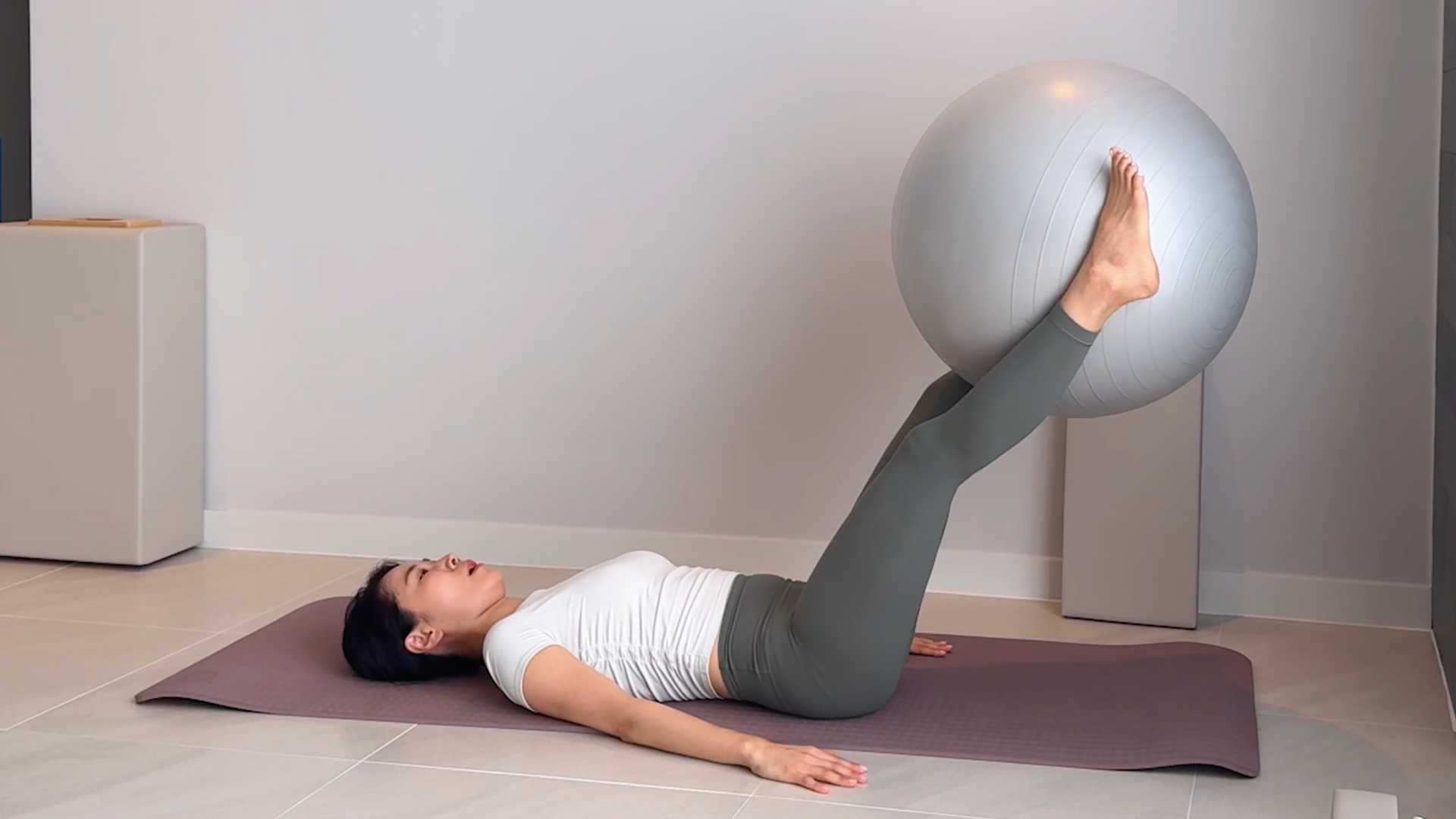
The Roll Over using the Stability Ball™ adds challenge and control to advanced matwork classes. This creative take on a classical Pilates movement leverages instability to deepen core engagement and increase proprioceptive demand.
Juhyun (Julie) Lee, Lead Instructor Trainer, Founder and co-manager of Breathe Pilates in Seoul, South Korea, demonstrates the exercise. Drawing from her background as a dancer and her teaching career focused on rehabilitation and movement training, Julie shares cueing techniques and practical tips for safe and effective practice.
Whether you’re training athletes, dancers or simply progressing clients ready for more spinal articulation and balance training, this variation builds essential control through the trunk, hips and spine without requiring large equipment.
Adding the Stability Ball™ to the Roll Over introduces controlled instability, requiring your client to work harder to maintain balance and alignment. This increases demand on the core, hip stabilizers and spinal support muscles while challenging their ability to move with intention and awareness.
Because the Ball reacts to even the smallest shifts, clients can’t rely on momentum or brute strength. They must move with purpose and control. That’s where neuromuscular precision comes in: the nervous system must communicate clearly and efficiently with the muscles to produce smooth, coordinated motion. This fine-tunes motor control, increases proprioception and strengthens mind-body connection, all essential for high-quality movement and long-term resilience.
The Payoff in Practice
- Less gripping or compensating with superficial muscles
- More control from the deep core and pelvic floor
- Better movement timing and smoother transitions
This makes the Roll Over using the Stability Ball ideal not just for advanced conditioning, but also for helping clients develop the kind of control that carries over into functional movement and injury prevention.
Set-Up & Equipment
All you need is a Stability Ball™ and a non-slip Pilates mat. This makes it ideal for:
- At-home clients with limited equipment
- Warm-ups in studio settings
- Outdoor or remote programming
*Pro Tip: Make sure the Ball is properly inflated. Too soft and the challenge disappears; too firm and it becomes difficult to stabilize between the legs.
Key Benefits
- Improves Spinal Articulation – Encourages mobility and segmental control from the neck (cervical spine) to the lower back (lumbar spine).
- Strengthens Core Muscles & Pelvic Floor – Requires deep activation of the abdominals and adductors to control the Ball.
- Develops Hip Mobility – Promotes a greater range of motion through the posterior hip line.
- Activates Inner Thighs – Constant engagement of the adductors supports Ball control and pelvic stability.
- Sharpens Balance & Coordination – The Ball’s instability challenges proprioception and postural control.
- Reinforces Functional Movement Patterns – Builds awareness, control and flexibility essential in everyday movements like bending, lifting and reaching overhead.
Julie’s Teaching Tips
- Move Slowly & with Control: Focus on articulating the spine one vertebra at a time for deliberate, precise movement throughout.
- Keep the Legs Parallel to the Floor: Legs should lift just enough to form a line parallel to the floor, encouraging even spinal flexion and hip control. Pelvic tipping or foot dropping may indicate loss of hip stability or overuse of back extensors.
- Protect the Neck & Head: Keep the shoulders grounded and maintain length through the back of the neck to protect the cervical spine. Cue the roll to stop at the upper thoracic spine, avoiding movement onto the neck. Watch for signs such as facial tension or neck strain that indicate the need for adjustment.
- Drive the Roll with Your Core: Emphasize initiating the movement through the abdominals rather than relying on the arms. The arms help stabilize but do not propel the roll.
- Activate the Adductors: Encourage steady engagement of the inner thighs to keep the Ball in place. Wobbling or slipping signals a disengagement of the adductors or pelvic floor.
- Avoid Using Momentum: Watch for swinging legs or sharp movements. These often mean the core isn’t engaged properly. Encourage slower initiation of each phase with deep abdominal activation.
Variations & Modifications
- Supportive Arm Position: For newer clients, keep the arms on the mat close to the body to help stabilize the shoulder blades and upper back.
- Progressive Arm Lift: To increase challenge, lift arms overhead during the roll. This challenges thoracic mobility and forces more core recruitment. Coordinating the arm movement with the spine articulation trains timing and flow.
Counterbalanced Movement for Spinal Health
A well-rounded approach to spinal mobility includes movement through all planes: flexion, extension, rotation and lateral flexion. Because the Roll Over focuses on controlled spinal flexion and articulation, it’s best paired with complementary exercises that balance movement in the opposite directions. This approach reduces overuse, enhances neuromuscular coordination and builds resilience in the spine and surrounding joints.
Source: https://www.merrithew.com/blog/post/2025-06-26/exercise-of-the-month-roll-over-using-the-stability-ball