
The Vertical Frame: Multiplanar Training for Reformers

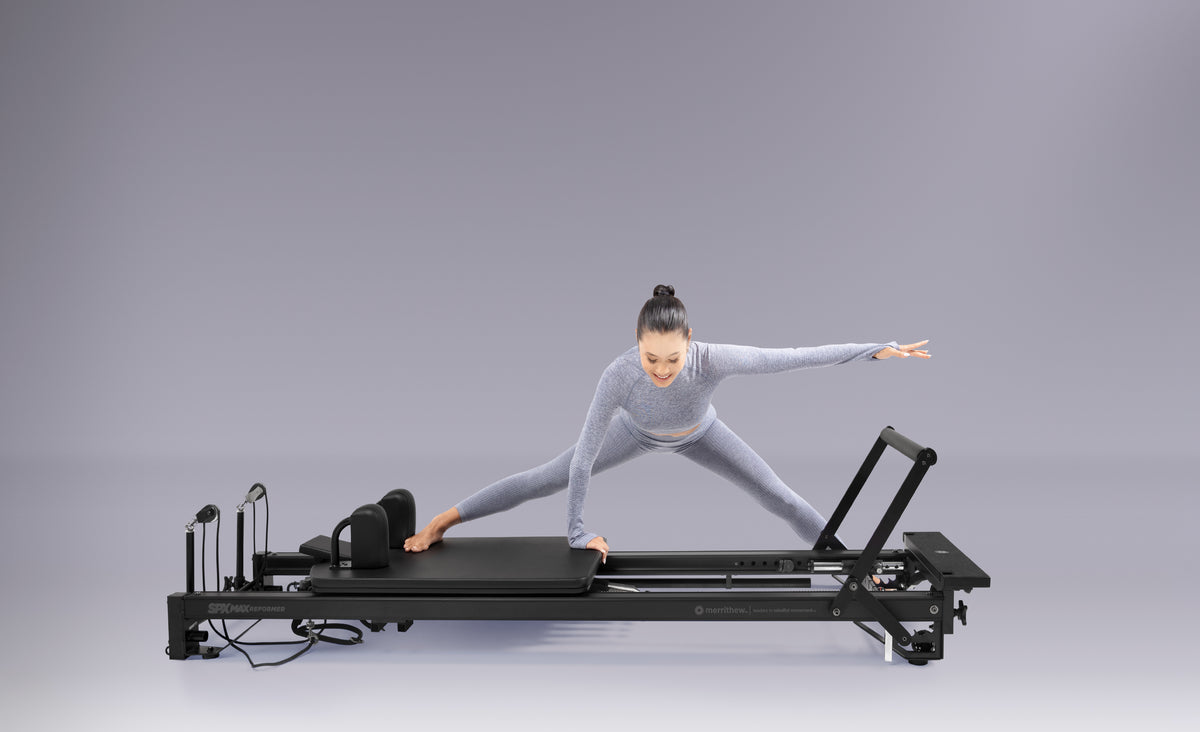
In many studios, the Reformer serves as the foundation of Pilates practice, supporting the development of movement patterns with precision and consistency. The carriage travels along a fixed track, and spring resistance follows a defined line of pull, allowing the body to organize efficiently while building strength, control, and awareness through repetition

With the addition of a Vertical Frame, spring attachment points extend above and around the body, introducing new vectors of resistance. This creates opportunities for multiplanar movement and expands programming beyond the traditional Reformer repertoire.

Within this integrated system, the Reformer functions as a virtual Cadillac, supporting an expanded range of exercises while remaining contained within a compact footprint.

Movement in All Planes

Adding a Vertical Frame expands how the Reformer can be used, introducing new spring positions and directions of resistance. Resistance is no longer limited to the horizontal plane of the carriage, instead, springs can be attached at varying heights and angles, introducing vertical and diagonal lines of pull.

This multi-directional resistance challenges coordination, stability, and proprioception throughout the entire kinetic chain. Rather than simplifying movement, it requires the body to organize more precisely in response to changing forces, supporting more dynamic and functional training.

Movement in All Planes

Expanded Repertoire Possibilities

The impact of the Vertical Frame is most evident in programming. With the inclusion of components such as the push-through bar, roll-down bar, and additional spring attachments, instructors can incorporate a wider range of exercises typically associated with the Cadillac repertoire.

This allows for greater emphasis on spinal articulation, scapular stability, and controlled mobility. Because resistance can shift in both angle and intensity, the body must continuously adapt, promoting balanced strength and improved movement efficiency.

Enhanced Feedback and Body Awareness

The Vertical Frame also enhances the feedback clients receive during movement. Because springs are anchored at elevated and varied positions, changes in alignment or control are more immediately noticeable.

This real-time feedback helps clients refine technique with greater accuracy, encouraging improved body awareness and reducing reliance on external cues. Over time, this supports more independent and consistent movement patterns.

Designed for Precision

The Vertical Frame is engineered to support the precision of the STOTT PILATES method. Features such as adjustable spring attachment points and traveling pulleys allow the line of resistance to evolve with the movement.

This helps maintain consistent tension throughout an exercise, minimizing abrupt changes in load and supporting smooth, controlled transitions. The system is highly adaptable, making it suitable for a wide range of body types and experience levels while maintaining stability and alignment.

Seamless Integration

The Vertical Frame is compatible with Merrithew V2 MaxSPX Max, and Plus Reformer models.

It integrates directly with the Reformer frame, carriage, and rope system, preserving familiar lines of pull while expanding exercise possibilities. This allows instructors to transition between exercises efficiently without significant equipment changes or interruptions.

The result is a cohesive system that supports progressive programming and fluid session flow, enabling more complex sequencing within a single setup.

Maximizing Studio Efficiency

For studio owners, a Reformer equipped with a Vertical Frame increases programming versatility without requiring additional floor space. Instructors can move seamlessly between rehabilitation-focused exercises and more advanced strength and mobility work, all on the same piece of equipment.

This efficiency supports a wider range of clients and class formats while maintaining a streamlined studio environment

A More Complete System

The Vertical Frame enhances the Reformer by expanding its capabilities within the STOTT PILATES method. It introduces greater exercise variety, supports multiplanar movement, and allows for more comprehensive programming.

The result is a versatile training environment defined by precision, adaptability, and depth, supported by equipment designed to evolve with both the client and the studio.


Source: https://www.merrithew.com/blog/post/2026-05-20/the-vertical-frame-multiplanar-training-for-reformers


Share

Related Posts

May 26th, 2026

The Vertical Frame: Multiplanar Training for Reformers

In many studios, the Reformer serves as the foundation of Pilates practice, supporting the development of movement patterns with precision and consistency. The carriage travels along a fixed track, and spring resistance follows a defined line of...

May 19th, 2026

The Multi-Unit Housing Advantage

How the Right Cardio Investment Protects NOI (Net Operating Income) In multifamily residential communities, competitive advantage is built long before the lease is signed. Prospective residents decide quickly, and often emotionally, based on...

May 12th, 2026

The Role of Pilates Equipment in Empowering Women

“Sustainable wellness begins with care.” — Lynn Grenier. In the Pilates industry, women serve as instructors, culture-builders, decision-makers, and architects of experiences. From programming and studio design to equipment investment and...

May 5th, 2026

How To Create a Sustainable Gym

Creating a sustainable gym isn’t just about reducing your environmental impact—it’s also a strategic move that benefits your business and attracts eco-conscious members. By implementing these key strategies, you can transform your fitness...

April 28th, 2026

The Select Hotel Advantage

For Select hotels, success is often won in the margins. You’re competing on experience, efficiency, and consistency all while balancing tight footprints, brand standards, and return on every capital decision. In that environment, amenities that...

April 21st, 2026

What You Really Need in Your Home Gym

Since the pandemic, when many gyms were forced to close, interest in home gyms has grown rapidly — and it shows no signs of slowing down. At Eleiko, we see it every day. Customers are building training spaces in garages, basements,...

April 14th, 2026

Building a Consistent and Sustainable Pilates Practice at Home

There’s a reason why it is called Pilates practice, and not Pilates perfect. When it comes to movement, we’ve all felt the pressure to get it right, the perfect form, the routine, the flow. But Pilates isn’t about perfection but...

April 7th, 2026

Is Pilates for Beginners? Everything You Need to Know to Get Started

Pilates has been transforming the way people move and feel for over a century. Once the secret training method of professional dancers, it’s now a mainstream mind-body workout practiced by millions worldwide. Unlike traditional strength...

March 31st, 2026

Why Accessories Deserve a Front-Row Seat in Facility Planning

They may not take up much floor space, but in a member’s hands, accessories can make or break the workout experience. From the grip on a dumbbell to the organization of a training station, these small details have an outsized impact on how members...

March 23rd, 2026

Beyond Cardio: How Indoor Cycling Became the Anchor of Group Training Spaces

Walk into a modern cycling studio today and it feels different than it did a decade ago. The lights are immersive, the music syncs with the ride, and the energy is electric, whether you’re a first-timer or a seasoned triathlete. Indoor...